
Social housing makes up a substantial portion of the UK’s property market, yet most people have little idea of its actual scale or how it operates.
The sector has changed dramatically over the past few decades. Policy shifts, demographic changes, and funding decisions have all reshaped what social housing looks like today.
So how many social homes are there? Who lives in them? And are there enough? Here’s what the latest data and national statistics show.
Key Findings
- Social rent is 50-60% of market rent and made up 79% of new lettings in 2023/24.
- Under-35s account for 64% of new general needs tenants, showing a clear tilt toward younger households.
- Children under 16 make up 33% of people in new social lettings, highlighting the focus on families.
- Women lead 57% of social housing households overall, rising to 73% among lead tenants aged 16–34.
- Black households are over-represented in social housing relative to their population share, while Asian households are under-represented.
- Lone parents comprise 18% of tenants and are far more common in social housing than in owner-occupation.
- Most new lettings go to people in acute need, including 27% who are homeless and 44% where someone has a long-term health condition.
- The UK holds about 5.36 million social homes, but the overall stock is shrinking due to sales and demolitions outpacing new builds.
- Right to Buy has driven the long-term loss of social homes, and replacements have not kept pace.
- Independent estimates say England needs around 90,000 new social rent homes yearly for at least a decade to meet demand.
What are affordable homes?
Social housing refers to homes provided by local councils or housing associations at below-market rents. These are made available to people who can’t afford private rental or homeownership, and they are typically allocated based on need through social housing wait lists.
Within social housing, there are different rent levels:
- Social rent is the most affordable option, set at around 50-60% of market rent. This is what most people think of as traditional council housing. In 2023/24, 79% of new social housing lettings were at social rent levels.
- Affordable rent allows landlords to charge up to 80% of market rent. Introduced in 2011, this higher rent level was meant to help housing associations fund new building. It now accounts for 19% of new lettings.
- Intermediate rent sits between affordable and full market rent, making up just 2% of lettings.
The distinction matters because “affordable” doesn’t always mean genuinely affordable. A home at 80% of market rent in London can still be out of reach for low-income families. That’s why housing campaigners often focus specifically on social rent levels when talking about housing need.
Who lives in social housing?
Social housing tenant demographics are diverse but certain groups are significantly over-represented compared to the general population.
Age
Younger people dominate new social housing lettings. Under-35s make up 64% of new general needs tenants, compared to just 43% of England’s overall population. This reflects allocation policies that prioritise families with children.
Children under 16 comprise 33% of people in new social lettings, showing how heavily the system focuses on housing families.
Gender
Women significantly outnumber men as lead tenants in social housing. 57% of social housing households have a female household reference person, well above the general population average.
This gap is even more pronounced among younger tenants. 73% of lead tenants aged 16-34 are women, largely because single mothers receive priority in housing allocations.
Ethnicity
Black households are nearly twice as likely to access social housing compared to their population share, while Asian households are significantly under-represented at roughly half their population proportion.
Asian households in England have historically had higher rates of homeownership, which may explain their lower representation in social housing. Black households face greater barriers to homeownership and higher rates of housing need.
White households closely match their population share, suggesting allocation systems work proportionally for this group. Mixed ethnicity and other ethnic groups also align reasonably well with their demographic presence.
Household Type
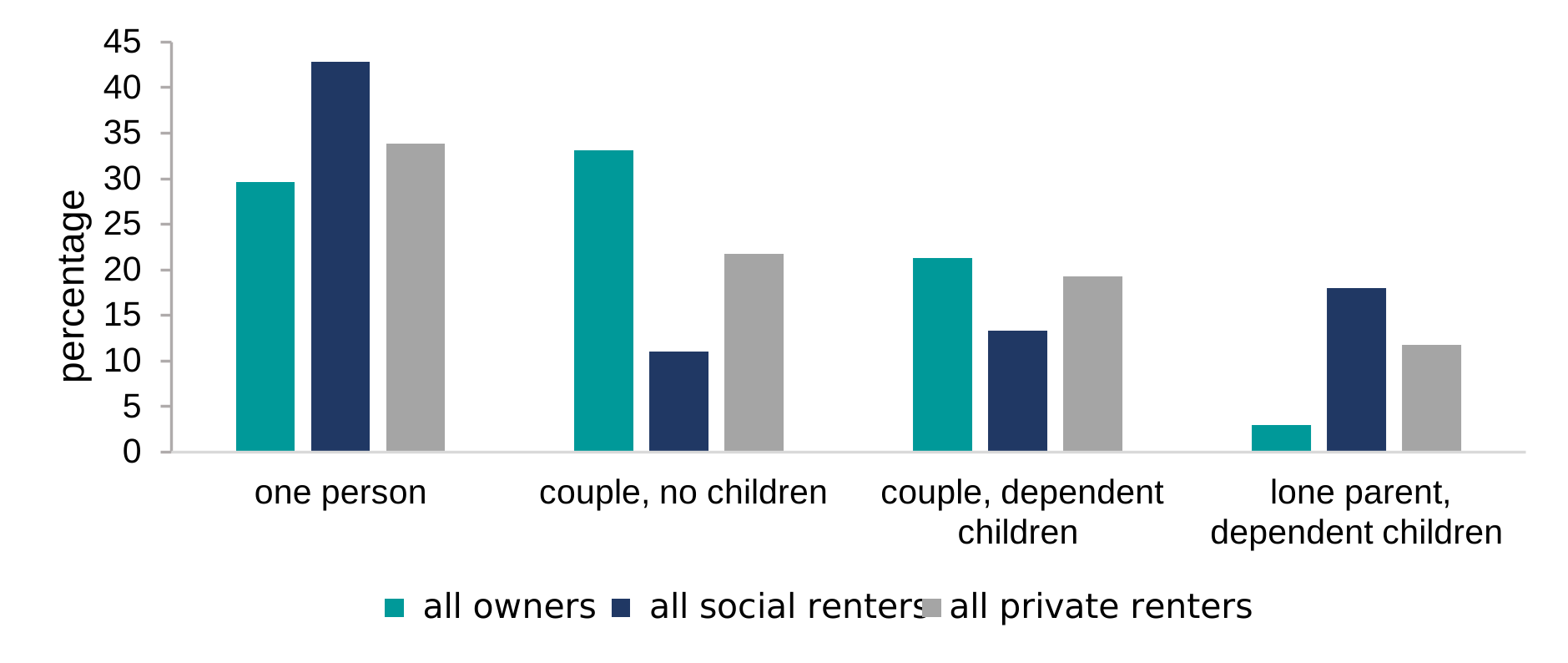
Source: English Housing Survey
Single-person households make up a large share because this includes older people, those with disabilities, and people leaving institutional care or homelessness – all groups given priority for social housing.
At 18%, lone parents are six times more represented in social housing than among homeowners. This reflects both the financial challenges single parents face and the fact that allocation systems specifically prioritise families with dependent children, especially where there’s been a family breakdown or domestic abuse.
Couples with children are less common in social housing than in owner-occupation. Two-income households generally have more options in the private market, meaning they’re less likely to meet the threshold for social housing need unless facing specific circumstances like homelessness or severe overcrowding.
Why do people need social housing?
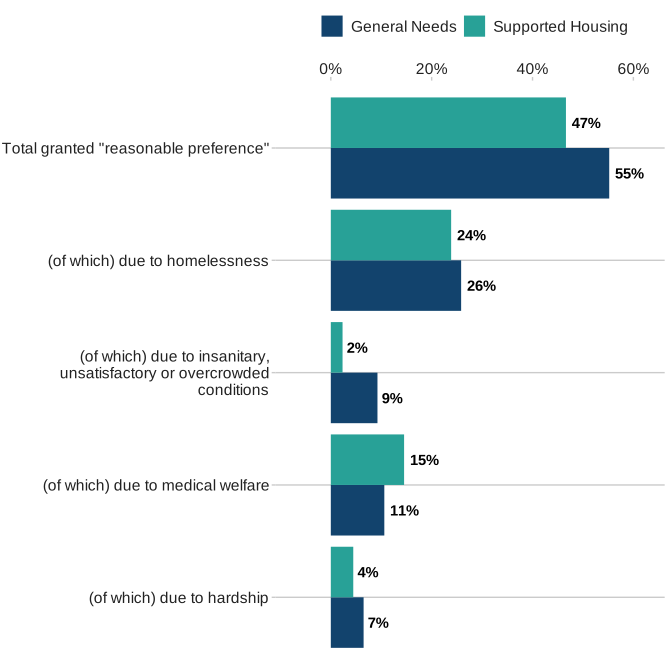
Source: gov.uk
Social housing allocation works on a system of ‘Reasonable Preference’, where local authorities must give priority to households meeting one or more specific criteria:
- Homelessness (or threat of homelessness in the next 56 days): 27% of new lettings in 2023/24 went to statutorily homeless households
- Insanitary, unsatisfactory or overcrowded conditions: Families unable to afford adequately sized private accommodation
- Medical welfare needs: 44% of households receiving new lettings included someone with a long-term physical or mental health condition
- Hardship: Low incomes make private rent unaffordable
Beyond these core criteria, other circumstances also lead people to social housing:
- Domestic abuse: 7% of households left their last settled home due to domestic abuse
- Refugees and asylum seekers: 2% of new lettings go to people granted refugee status or humanitarian protection, reflecting the UK’s resettlement programmes
The figures show that social housing primarily serves people facing acute need rather than those with low incomes. The high proportion of tenants with health conditions and those who are homeless demonstrates how the allocation system prioritises the most vulnerable.
How many social homes are there in the UK?
As of 2024, the UK has approximately 5.5 million social homes. The distribution across the four nations breaks down as follows:
Country | Number of Social Homes | % of UK Total |
England | 84% | |
Scotland | 12% | |
Wales | 5% | |
Northern Ireland | 2% |
Across the UK, social housing is split between housing associations (or Registered Social Landlords) and local councils. In England and Wales, housing associations now manage around two-thirds of stock, while councils retain about a third. This reflects decades of Right to Buy sales and stock transfers that have shifted the balance away from direct council ownership.
Scotland and Northern Ireland maintain stronger public sector involvement, with approximately 620,000 and 120,000 homes respectively.
Property Types
According to the Regulator of Social Housing, England’s social housing stock breaks down into three main categories. The statistics show that around 82% of social homes in England are general needs (social rent and Affordable Rent), while supported housing makes up 11% and Low Cost Home Ownership 6%.
How many social landlords are there in the UK?
Social housing in the UK is provided by thousands of organisations, ranging from massive housing associations managing tens of thousands of properties to small, specialist providers focused on particular communities or needs.
As of 2025, there are an estimated 2,008 social housing providers across the UK, though this figure includes many small organisations alongside the major players.
Country | Housing Associations / RSLs | Local Authorities | Total Providers |
England | Over 1,600 | Around 180 | |
Scotland | Approx. 158 | 32 | |
Wales | Approx. 35 |
England dominates the sector with 1,780 providers, though not all councils still own housing stock – many transferred their homes to housing associations in the 1980s and 1990s, leaving only around 180 that remain as direct landlords. Scotland maintains a different model where all 32 councils still own and manage housing, unlike in England, where many have exited direct provision.
Why are social homes declining in the UK?
The UK’s social housing stock has been shrinking for decades. Despite growing demand, the numbers keep falling. Several factors drive this decline, but one policy stands out above all others.
Right to Buy
The Right to Buy scheme, introduced in 1980, remains the single biggest reason for the declining social housing stock. The policy gave council tenants the right to buy their council homes at significant discounts, and its impact has been huge on the social housing sector.
Over 2 million social homes have been sold since 1980, yet only 2% of sold homes have been replaced like-for-like. 260,000 net social rent homes have been lost in the last decade alone.
The financial mechanics make replacement nearly impossible. Discounts of up to 70% mean councils often can’t afford to build replacements. In practice, it can take six Right to Buy sales to fund building one new social home. Government rules restrict how councils can use Right to Buy receipts, further hampering their ability to rebuild stock. The policy continues to strip away social homes faster than they can be replaced.
Insufficient Replacement Building
Even without Right to Buy, the UK simply isn’t building enough social homes to meet demand. In 1980, 94,000 social homes were built, but by 2023, only 9,500 social homes were delivered – a 90% drop. This is even further from the post-war peaks when the UK built over 100,000 social homes annually in the 1960s.
In 2023/24, England lost 650 social homes overall. While 19,910 new social homes were delivered, 20,560 homes were lost through Right to Buy sales and demolitions. Over 5,700 homes were gained through tenure changes from affordable rent to social rent, but the new builds barely offset the losses, resulting in a net decline even in a year when construction picked up.
Policy & Funding
There was no significant government funding for social rent available between 2010 and 2021 – a lost decade for building. When funding did return, it prioritised affordable rent at up to 80% of market rates rather than genuinely affordable social rent. This produces homes that are still out of reach for many low-income families.
Austerity cuts reduced local authority capacity, meaning councils lack the staff, expertise, and resources to develop new housing. Complex planning processes delay development, adding time and cost to every project. Current conditions make building even harder: rising construction costs have made materials and labour significantly more expensive, land availability is limited, especially in high-demand areas, a skills shortage in construction workers and housing development expertise, and housing associations face borrowing capacity limits.
The result is a perfect storm. Homes continue to leave the social housing stock through Right to Buy, while replacement building crawls along at a fraction of what’s needed. Without dramatic policy changes, the decline will continue.
Does the UK need more social rented housing?
According to Shelter, 1.33 million households are on official waiting lists in England, with half a million additional families in need but not on waiting lists. In total, 4.2 million people, including 1.3 million children, are in housing need.
164,040 children are living in temporary accommodation, and around 354,000 people are homeless in England as of December 2024, with record numbers in temporary accommodation for the fifth consecutive quarter. Temporary accommodation was never meant to be a long-term solution, yet families are spending years in unsuitable, expensive emergency housing because there aren’t enough social homes available.
Regional Variations
The shortage affects different areas with varying severity. London faces the most acute crisis, with some boroughs having 100+ year waiting lists for family homes. The capital has 336,366 households on waiting lists – the highest absolute number in the country.
Northern England generally has shorter waits but still faces substantial unmet need, while rural areas present particular challenges. Due to limited stock, people struggle to access any social housing options. As one example, Sandwell projects a need for 39,726 additional social and affordable homes by 2041.
How many new social homes are needed?
Housing charities and research organisations have calculated the scale of investment – Crisis, Shelter, and the National Housing Federation estimate that 90,000 social rent homes per year are needed, requiring 10 years of sustained building to address the current backlog. The financial requirement is substantial, with £15 billion estimated to house all families currently in temporary accommodation alone.
Building 90,000 social homes would add £51.2 billion to the UK economy and create 140,000 construction jobs in a year. Currently, £12 billion is spent annually on private rental housing benefits, costs that would be reduced with more social housing.
Government Targets vs Reality
The government has announced ambitious plans but faces significant delivery challenges. Current commitments include a 1.5 million homes target for England by 2029, a £39 billion Social and Affordable Homes Programme over 10 years, and an ambition for 300,000 social and affordable homes from the new programme, with a 60% social rent target (approximately 180,000 homes).
The current delivery rate is only 9,500 social homes per year, with net losses continuing – 650 homes lost in 2023/24 despite new building. Housing associations are reducing development programmes due to financial pressures, creating capacity constraints. Meeting the target of 90,000 new homes annually would require almost a tenfold increase from current delivery rates – that’s the scale of transformation needed.
Invest in Social Housing in England with Yield Investing
Social housing offers a unique investment opportunity. With strong demand, government backing, and stable long-term returns, the sector provides an alternative to traditional property investment.
Yield Investing specialises in social housing investments in the North East of England, connecting investors with opportunities in this essential sector. If you’re looking for steady income, portfolio diversification, or socially responsible investments, social housing delivers on all of these fronts.
Ready to explore social housing investment? Contact Yield Investing to discover how you can benefit from this growing sector while making a positive social impact.