
Gross yield tells you how much annual rental income a property generates relative to its purchase price or market value, expressed as a percentage. It’s calculated before deducting any running costs, making it the quickest way to gauge whether a property warrants closer investigation.
The Gross Yield Formula
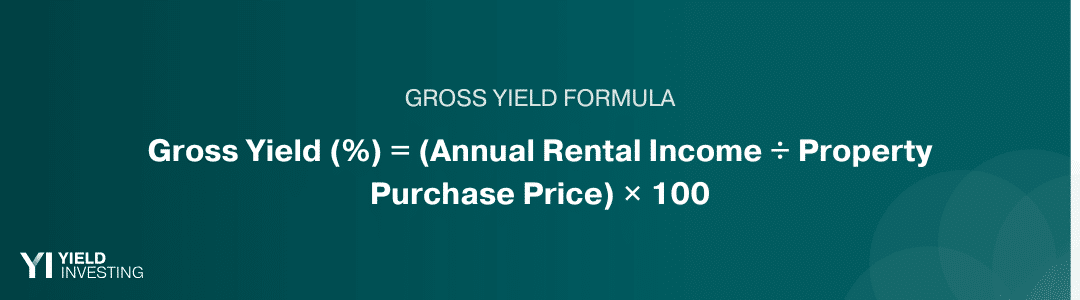
Gross Yield (%) = (Annual Rental Income ÷ Property Purchase Price) × 100
A flat purchased for £250,000 that generates £15,000 in yearly rent delivers a gross yield of 6%:
(£15,000 ÷ £250,000) × 100 = 6%
A house bought for £180,000 earning £10,800 annually also produces 6%, even though the absolute income differs:
(£10,800 ÷ £180,000) × 100 = 6%
How Gross Yield Works in Practice
This simplicity makes gross yield valuable for rapid comparison. When you’re scanning listings across different regions or property types, it instantly reveals which assets might deliver stronger income returns. Northern cities often show higher gross yields (7-9%) compared to London (3-5%), though this rarely tells the full story about actual profitability.
The limitation is equally important to understand: gross yield ignores every expense you’ll face as a property owner. Mortgage interest, maintenance, insurance, letting fees, service charges, and void periods all reduce your real returns. A property showing an attractive 8% gross yield might deliver only 4% once you’ve paid for everything. That’s why experienced investors treat gross yield as a screening tool rather than a decision-making metric.
Pro tip: Calculate gross yield using either purchase price or current market value, depending on your purpose. When evaluating a potential purchase, use the asking price. When assessing your existing portfolio’s performance, use the current open market value to understand real-time returns.
When Gross Yield Matters Most
Use gross yield during initial market research when you need to eliminate unsuitable opportunities quickly. If you’re targeting income-focused investments and spot properties yielding below 5% in secondary locations, you can confidently move on. Similarly, if you see exceptionally high gross yields (10%+), it often signals higher risk – perhaps difficult tenants, poor property condition, or unstable local markets.
Gross yield will also differ by location. Student accommodation in university towns may achieve gross yields of 8-10%, while family homes in commuter belts typically yield 4-6%. Supported housing and HMOs often show double-digit gross yields, but these come with intensive management requirements that affect net returns.
Gross Yield vs Net Yield
Gross yield shouldn’t stand alone in your analysis. Two properties with identical 7% gross yields can perform completely differently once you factor in a new-build’s minimal maintenance versus an older property’s repair costs, or a leasehold’s service charges versus a freehold’s independence.
Always progress from gross yield to net yield calculations before committing capital. The difference between these figures reveals the true cost of ownership and separates genuinely profitable investments from superficially attractive ones.